
All projects
ActiveCase study
Sabu's World — Multivendor E-commerce & Retail Management Platform
A responsive online store, referral-commission system, and all-in-one retail operations dashboard.
Overview
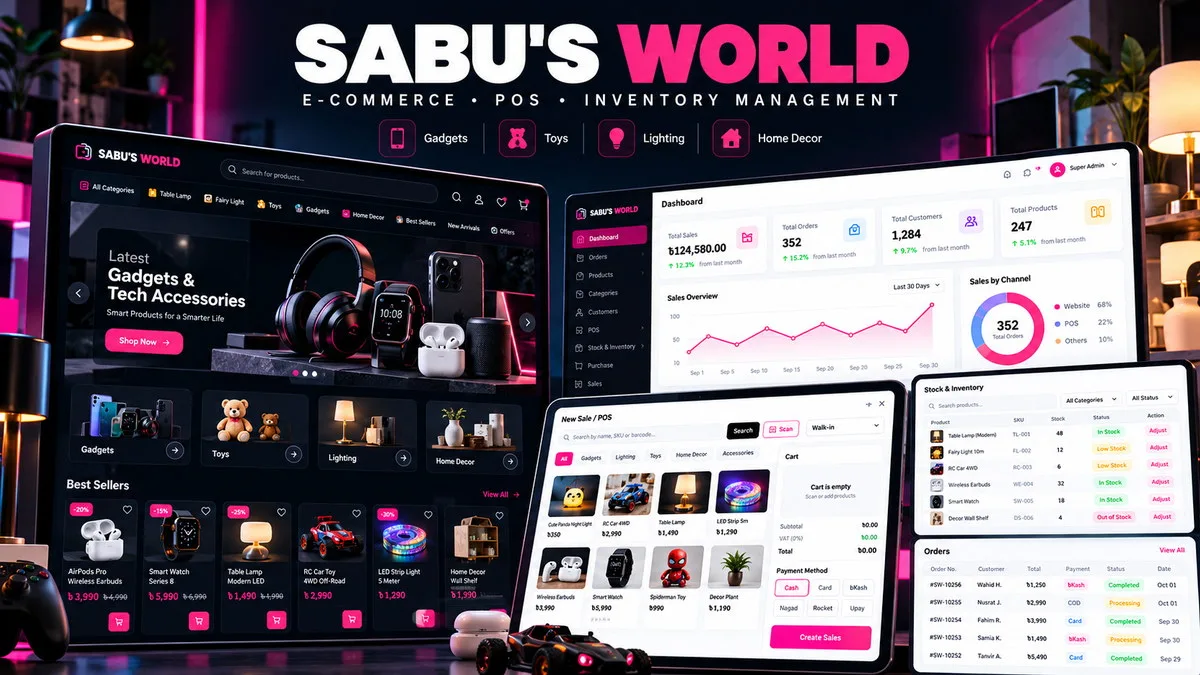
Sabu's World is a responsive, multi-channel commerce platform that combines an online storefront, referral-based selling with commission dashboards, an admin dashboard, and an in-store Point of Sale (POS) system.
Customers can explore product categories, discover trending products and special offers, place online orders, and follow order and delivery updates. Users can refer products and access referral profiles to view their commission information.
The admin panel centralizes product, category, inventory, barcode, coupon, discount, order, payment, customer, staff, and expense management. The POS supports counter sales, product search, barcode/SKU entry, discounts, and configured payment options, including bKash and Nagad.
The platform also includes staff permission controls, customer due reminders, salary and expense records, push notifications, order tracking, customer communication tools, and reporting across online and physical-store sales.
What I built
I built a responsive storefront for browsing categories, viewing product listings, finding featured and trending products, and exploring offers across desktop and mobile layouts.
I developed an administration panel for managing the product catalogue, categories, inventory, barcodes, stock levels, customer reviews, orders, payment status, coupons, discounts, promotional offers, shipping settings, and store configuration.
I implemented a Point of Sale (POS) workflow for physical-store sales. Staff can search for items or scan or enter a barcode or SKU, add products to a cart, apply a discount where permitted, select an available payment method, and complete a sale. Available options can include cash, card, cash on delivery, bKash, Nagad, Rocket, and Upay, according to the store configuration.
I included referral-based selling features so users can share product referrals and use their profiles or dashboards to review related activity and commission information. I also included staff access controls so staff accounts can be limited to the sections and actions assigned by an administrator.
The wider operations workflow covers credit or due sales, customer balance follow-up and reminders, staff salary records, business expenses, online and in-store sales records, pending payments, product and order status updates, push notifications, tracking tools, and analytics or pixel-tracking configuration.
I used PHP and Laravel for application development and MySQL for relational data storage. The project brings storefront activity and administrative workflows together in one system.
Why I built it
The goal was to provide one practical system for a business that sells through both an online storefront and physical retail locations. Managing web orders, counter sales, products, stock, promotions, payments, staff, customer balances, and expenses in separate tools can create duplicated work and inconsistent records.
I designed the platform to centralize these workflows while giving customers a convenient shopping experience and giving authorized staff access only to the tools they need. Referral and commission features also provide a way for users to help promote products, while the admin dashboard makes operational information easier to review.
Problems solved
The platform addresses the operational gap between online sales and physical-store sales by keeping product, stock, order, payment, and sales workflows connected. It reduces the need to manage each process in a separate place and helps administrators review activity through a central dashboard.
It also supports common retail needs such as barcode-based product selection, discounts and coupons, pending-payment follow-up, credit-sale records, customer due reminders, staff permissions, salary and expense records, and sales reporting. Referral profiles and commission information give participants a clearer way to follow their referral activity. Order-status and tracking features help customers follow fulfillment progress when tracking information is available.
What I learned
This project strengthened my experience in planning a multi-module business application with PHP, Laravel, and MySQL. It involved thinking through the relationships between products, categories, inventory, orders, payments, customers, staff permissions, and financial records.
I also gained practical experience designing workflows for both e-commerce checkout and in-store POS sales, separating staff access by permission, and presenting operational information through dashboards and reports. Building the bilingual project content and responsive storefront reinforced the importance of clear information architecture, consistent terminology, and usable interfaces across screen sizes.
The project further highlighted the importance of carefully handling payment states, stock changes, credit balances, customer reminders, notification flows, and tracking status so that business records remain understandable and consistent.
UI / UX showcase
Project gallery
Desktop and mobile views from the product. Select an image to open the fullscreen viewer.